

While butterflies and moths are not generally as efficient pollinators as some other insects, they do their bit.
Photo: Dougy Wright
BUTTERFLIES AND MOTHS Q&A
Most people know butterflies are pollinators, but so are moths. Here we’ve answered a few questions about moths and butterflies. You can see plenty of both on The Lizard, and we’d love you to get out and do some counting during the Big Butterfly Count each year.
How closely are butterflies and moths related?
They are all included in the scientific order of insects called Lepidoptera, so they are closely related. Lepidoptera is from the Latin meaning ‘scale-winged’: all butterflies and moths have powdery scales on their wings that rub off over time. That’s why their colours start to look a bit jaded as they get older.
How many species are there in the UK?
There are 59 butterfly species, over 40 of which can be spotted in Cornwall. There are far more moth species across the UK – about 2,500, in fact.
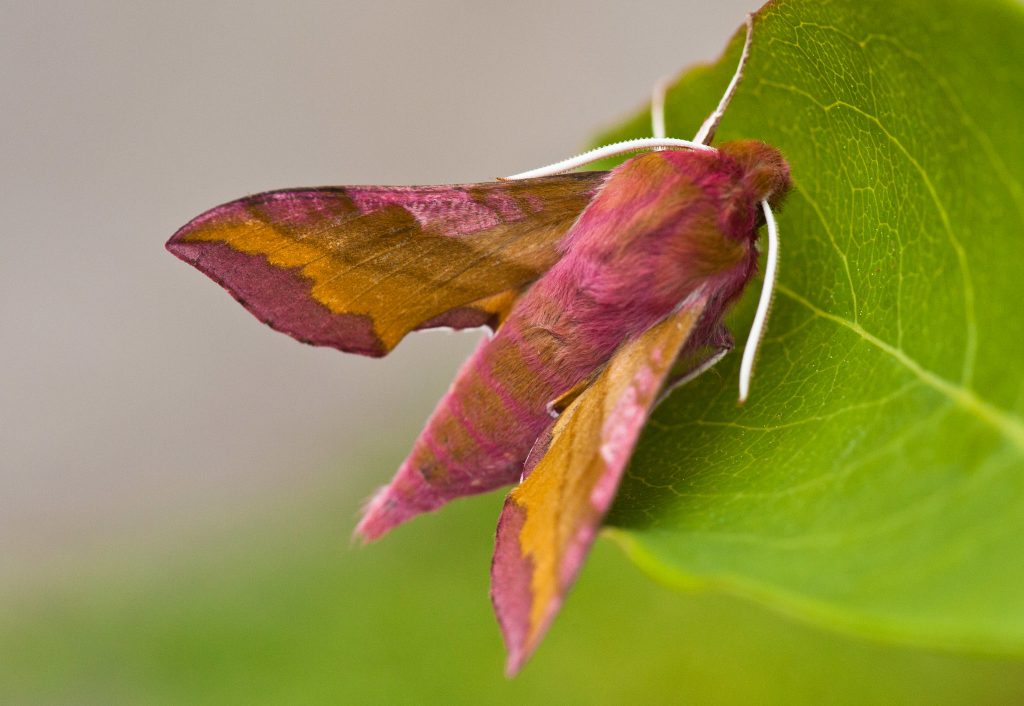
Moths are all dull brown, aren’t they?
No! Many are superficially brown, but even those that are generally have intricate patterns on their wings. There are also several species that have beautiful and bright colours, such as Tiger moth species and the Five- and Six-spot Burnet Moths. While many butterflies do have vibrantly coloured wings, don’t forget that some, such as the Ringlet, are brown (though still subtly beautiful).
Is it true that butterflies fly by day, and all moths fly by night?
Yes and no. Butterflies are day-flying insects (they are diurnal) but, while most moths are nocturnal, there are several species that fly by day. These include the Hummingbird Hawk-moth and male Emperor moths.
How can I tell butterflies and moths apart?
There are a few features that differentiate them, although bear in mind there are always exceptions to the rules. Here are two key pointers that are fairly easy to see:
- At rest, unless they are basking, butterflies usually hold their wings upright and together (Skipper species are an exception). Moths generally hold their wings flat over their backs or spread sideways.
- Butterfly antennae are club-shaped i.e. they are wider at the tips. Moth antennae are usually wider and often feathery: even if thinner, they are not club-shaped.
Do all moths eat clothes and carpets?
No. In the UK there are just two species of Clothes Moth – the Common Clothes Moth and the less common Case-bearing Clothes Moth – that cause damage to textiles. Two species of House Moth – the Brown and the White-shouldered House Moth – may also cause damage. That’s only four out of 2,500 species. It’s the larvae, not the adults, that do the munching.
Are moths and butterflies good pollinators?
They’re not as efficient as other pollinators, such as bees, because pollen doesn’t stick to them very well, but they have a part to play. Larger moths, such as the hawkmoths, are in fact very good pollinators.
Published: July 2015
Author: Amanda Scott
Photos: Top – Comma (Dougy Wright); lower – Small Elephant Hawk-moth (© Natural England/Allan Hewitt)