
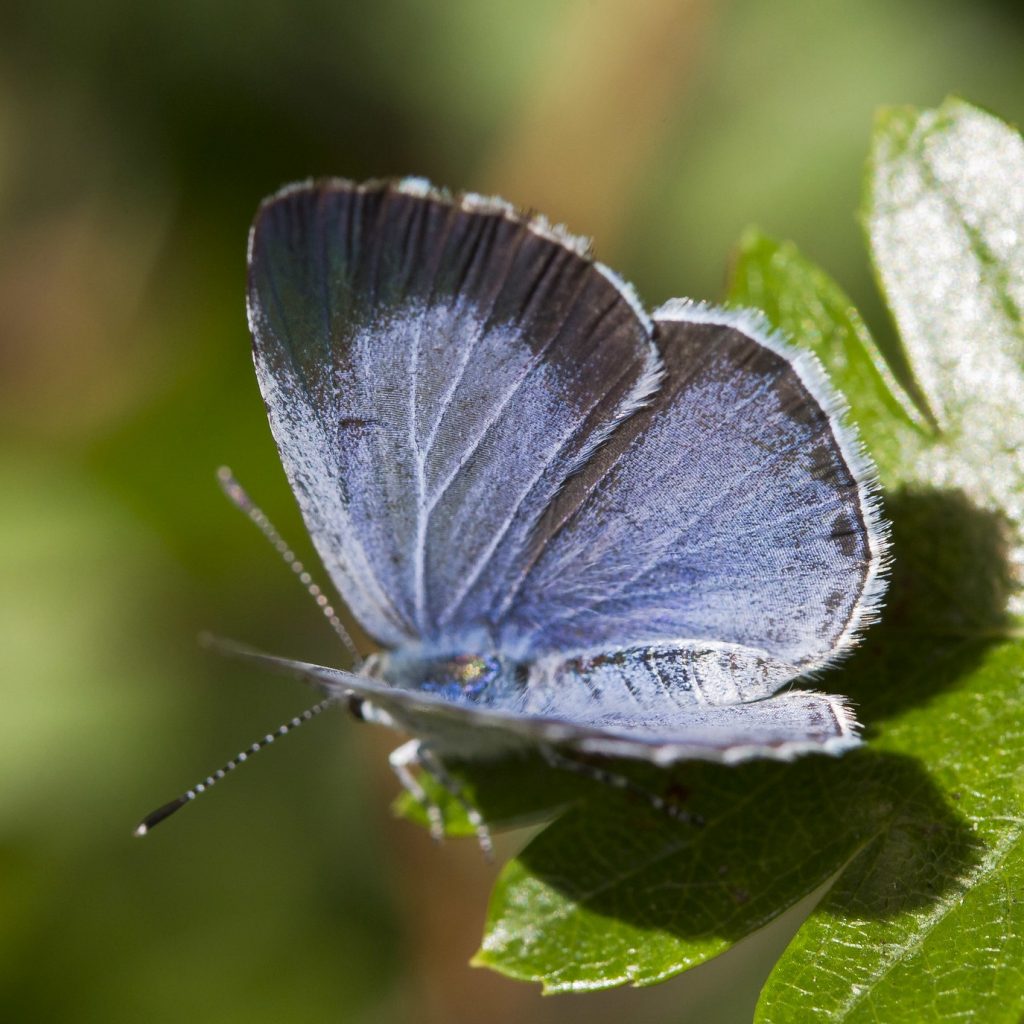
The pretty Holly Blue is a butterfly of early spring and late summer.
Photo: © Natural England/Allan Drewitt
Scientific name: Celastrina argiolus
Cornish name: ‘Tikki-dui’ is the general word for butterfly
Status: GB Red List: Least Concern
What to look for:
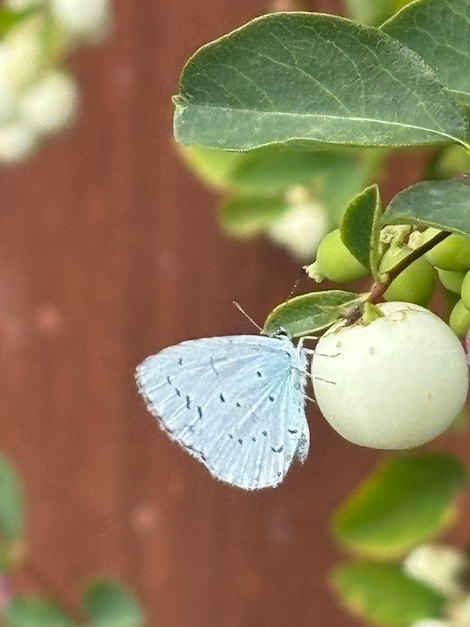
- Colouring: The upperside of the wings is bright blue, while the underwings are a pale grey-blue with a smattering of black markings and black edges in the females. The dark band on the forewings of second brood females is much broader than in the spring generation.
- Size: Wingspan: 26 to 34 mm.
- Where: Mainly found in southern Britain, though its distribution is spreading northwards. Woodland, parks, and a fairly frequent garden visitor.
- When: April and May, with a second generation in mid July to early September. In favourable conditions, there may be a third brood in autumn.
- Similar species: Common Blue; the different patterns on the underwings of the two species are distinctive.
A Holly Blue is easy to confuse with a Common Blue on a quick fly-past, with their blue upperwings of similarly lovely brightness. However, if you get a chance to see the underwings, the patterning is very different between the two species. The first generation of the Holly Blue is also on the wing earlier than the Common Blue.
The green caterpillars eat the flower buds of their host plants – mainly Holly in the spring, Ivy in summer, as well as others such as Gorse, Bramble and Dogwood.
Did you know…?
… The Holly Blue is not of conservation concern, but numbers fluctuate strongly between years. The most likely cause is a parasitic ichneumon wasp that lays eggs in the Holly Blue larvae. As Holly Blue caterpillar numbers rise, so too does the parasitic wasp population. The resulting increase in parasitism causes a collapse of the Holly Blue population, which in turn means the wasp population crashes, and Holly Blue numbers recover. And so it continues, in a boom and bust cycle.
More information and references:
Board, S., Besterman, T., Dawson, B., Goodere, D., Goodere, M. and Poland, C., 2021. Butterflies of Cornwall: Atlas for the Twenty-first Century. Pisces Publications, Berkshire.
Websites:
Published: June 2026
Author: Amanda Scott
Photos: Top – © Natural England/Allan Drewitt; lower – © Natural England/Matt Stone